What is a brain-body conflict?
The brain-body conflict happens when social expectations come in direct conflict with my physical/cognitive ability to maintain the social rules of the situation. Often, physical/cognitive limitations and warning signs are ignored out of not wanting to violate a social taboo.
Here’s an easy example of brain-body conflict:
In the U.S. “happy hour” is scheduled at the end of the workday and is typically designed around drinking half-price alcoholic beverages with coworkers, with more relaxed social mores than are present at the office. People are supposed to either “have fun”, gossip, or commiserate. Happy hours are supposed to be noisy, people are expected to talk loudly and be visibly engaged. Happy hour must last at least one hour or all night depending on the social group. If you are the first to leave, refrain from alcohol, or if you opt out, it is usually met with disapproval.
For years, I accepted the social narrative around happy hour. I believed it was the only avenue available to me in my job to increase out of office friendship with people. I accepted that when I went to happy hours, I was miserable and that it was my fault that I failed every time to have a good time and to make friends. What I didn’t understand was that after a long week of work and a cognitively exhausting job, my body was never going to be up for happy hours. And to put myself in that position was detrimental to my mental health.
Here’s how brain-body conflict plays out in real life: I want something positive, e.g., socialization/friends, and optimistically sign up for it and attend with the best intentions. At some point I get overwhelmed and instead of listening to myself and leave when I am still having fun (or at least not miserable), I stay past my endurance or am prompted/required to stay by others, and everything goes haywire. At which point I may say or do things I regret later. See my excellent comic below.
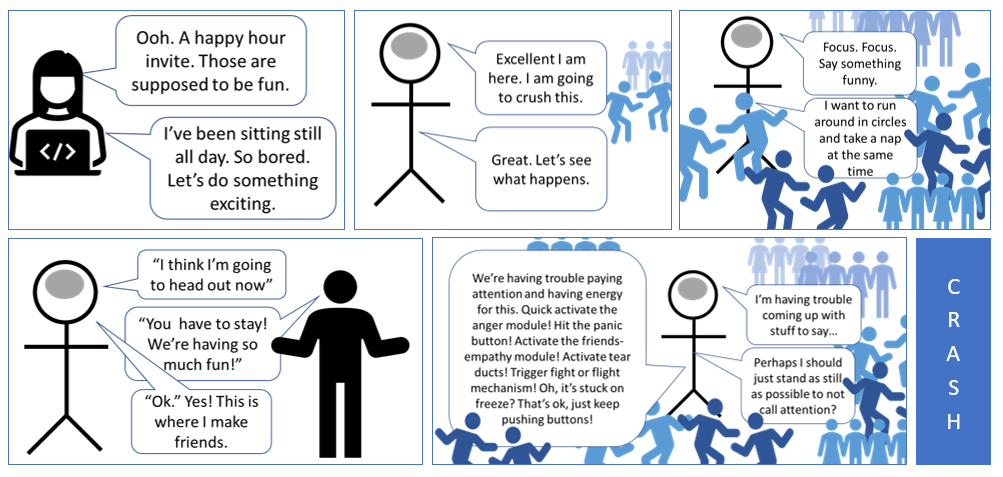
There are many solutions to this problem. The first is to choose activities more suited to me (subject of another post), the second is to pay attention to signs of brain-body conflict and to remove myself from situations for a break, or leave the situation in a socially acceptable way (optional) and head home.
Brain symptoms:
- Hyperfocus on social rules of the situation, e.g., I need to stay in this seat during this lecture, happy hours are at least one hour
- Looking for validation of payoff from the social situation — “I’m not leaving until I have fun” or “I was having fun, I’ll just continue to stay until I have fun again”
- Sunk cost fallacy – “I showed up to make friends, I’ll leave when I have them”
- Waiting for a certain person to provide validation
- Denial of my physical/cognitive experience because it’s not what I wanted to happen or how I pictured this playing out
Physical signs of brain-body conflict:
- New or escalated pain / soreness
- Hyperactivity or difficulty controlling movements
- Exhaustion
- Difficulty focusing eyes, differentiating sounds
- Inability to retain sensory focus on activity or person
- Increased clumsiness
Psychological signs of brain-body conflict:
- Loss of interest during activity
- Inability to form sentences or remember anecdotes to share
- Difficulty retaining attention and ability to take in information and process it (e.g., unable to follow along with a story or instructions)
- Irritation or irrational anger, increased negative judgement of others, lashing out, saying things I had previously decided were inappropriate
- Release of emotion afterward stimulus is removed – relief, anxiety, sadness
- Sudden or gradual increase of system arousal (non-sexual, e.g., breathing rate, heart rate, skin irritation) past point of comfort
- Claustrophobia, feeling trapped
- Confusion, inability to make choices
So, what do I do?
Start paying attention to when you are beginning to experience brain-body conflict and come up with coping mechanisms that allow you to take a break or to gracefully exit before you go nuclear or ruin everyone else’s night.
 The Friend Manual: How to make friends when you're bad at it