When I was writing up my previous post about brain-body disconnect, I went down a rabbit hole thinking about stimulus levels at events. Usually I just think about them on an axis of less stimulation to more stimulation. But this time I used a quadrant model and came up with some interesting insights about events
Digression #1: Interestingly, choosing a different model on a whim gave me new insights, and the conclusions are still valid. Which means that both models are correct and neither is incorrect, though the conclusions differ. It’s good for me to learn that no approach is “correct” and invalidates all others and therefore, I can not be completely “right”, which is something I am struggling with in writing this blog about a really squishy subject.
Welcome to the event stimulus model with two axes
On the vertical axis, there is a range from external stimulus at the top, to internal stimulus at the bottom.
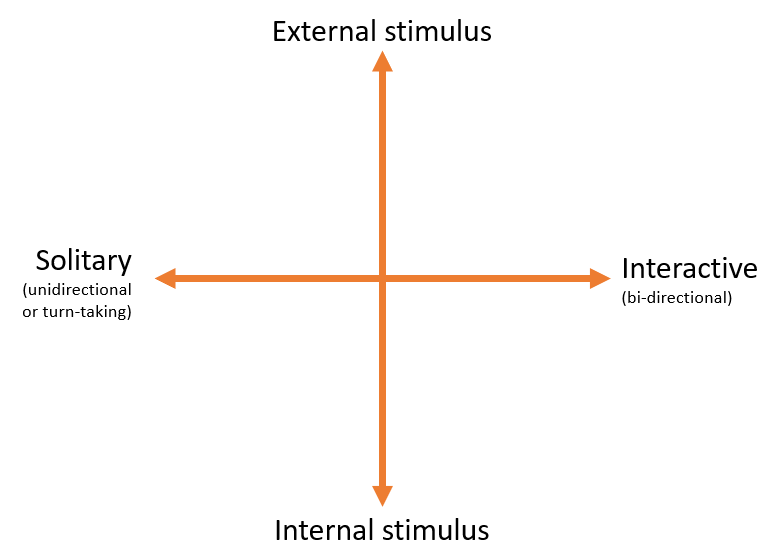
External stimulus includes people, sounds, visual stimuli, temperature, etc. An example of a highly external experience is a stadium concert, which is designed to be immersive and precludes conversation and cognition until afterwards.
Internal stimulus encompasses brain-body stimulation like muscle use, thinking hard, contemplation. An example of a highly internal experience is a game of chess wherein the players are often silent in between turns and spend all of their time thinking.
Interestingly, the further from center you get in an activity, the more it precludes the opposite processing. E.g., it’s hard to think during a stadium concert and it’s hard to play chess in a noisy environment.
Center (0,0) is someone sitting quietly at home – relaxed, no stimulation and no stressors.
On the horizontal axis, there is a range between solitary (left) and interactive (right). This axis is only concerned with the amount of interactivity between living things, not interactivity with objects or environments – that would be associated with external stimulus in this model.
Solitary activities are performed in a few ways. It can be something done by yourself (solo – such as a a hike where everyone is in a straight line and not talking), something where you are expected to attend and listen passively (unidirectional – such as a lecture), or an event where individuals share ideas or perform tasks, but interaction is not expected (turn-taking – such as show-and-tell).
Interactive activities are performed with multiple people with all people participating (bi-/multi-directional). The further to the right from center indicates that people must work together to create a shared experience and one person’s choice influences the other, and vice versa, such as salsa dancing where one person moves and the other person must move in tandem. Another highly interactive activity is group brainstorming / problem-solving or group conversations where ideas are shared and built upon sequentially.
Digression #2: This is an imperfect model. I can think of several reasons where it doesn’t quite work, but it’s useful enough. Every simplified model of complex systems must preclude some variables to exist.
And now onto the quadrants
Every dual axis model of social sciences is primed for quadrant definitions. It was curious to me that I hadn’t thought of this before, because it shed some light on why certain activities are more challenging to me, and which types of activities I may have more fun doing if I approached them in different ways.
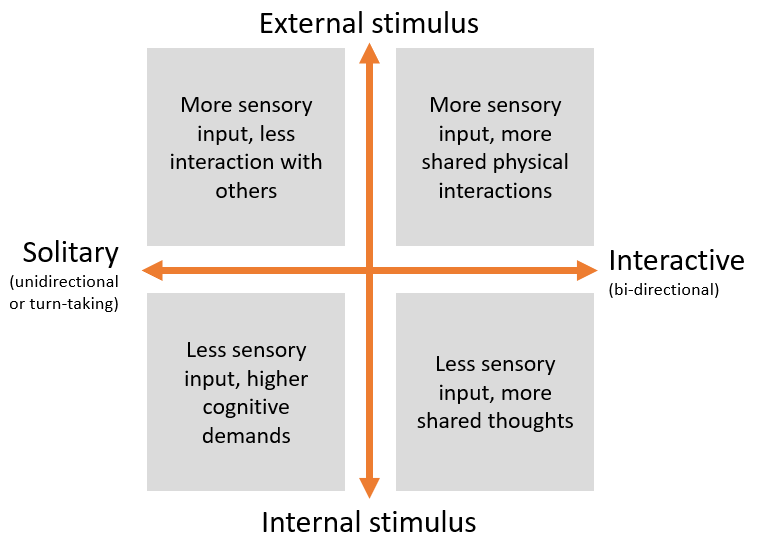
The quadrants below are discussed in clock-wise order from the top-left.
External stimulus – Solitary
This quadrant indicates activities that are high in external stimulus and require strict focus on the event or stimulus (e.g., classical music concerts, movie theaters, museums, lectures). These events usually have strict social norms on how to behave, the amount of noise/movement you can make, whether laughter is appropriate. The further out you get on both axes, the more punitive the social rules are.
These tend to be great events for people who are intellectually inclined and ready to take in a lot of information. They require the greatest intensity of sensory regulation without being able to move around to release any body tension during the event.
How does this help? I’d probably do better sitting through a broadway show if I went for a couple runs in the days leading up to the show to tire myself out – I’m a fidgeter.
External stimulus – Interactive
This quadrant indicates activities that are high in external stimulus and require interaction between event participants to perform the activity “correctly” (e.g., amusement parks, partner dancing, scavenger hunts). The more planned the activity, the stricter the social norms are, and, once the activity has commenced, you are locked in until the end.
These tend to be the events that have the highest energy required for both sensory processing and social/emotional regulation. For people who enjoy them, they have a high payout.
How does this help? If I am planning to go to an amusement park, it’s probably best to have a day (or 5!) before be very low-key to the point where I am bored. Regular breaks should be planned and, if I can afford it, maybe I can break it up into two shorter days, instead of going hard all day.
Internal stimulus – Interactive
This quadrant indicates activities that are lower on external stimulus, but higher on language/social processing and require back-and-forth interaction with participants. These types of activities rely on participation to make the event work. People who choose to opt out of participating make it harder for the people who do actually participate to create a sustainable event cadence. However, if certain people dominate the event, then it either allows or forces the quieter attendees to passively participate. It’s a hard balancing act and requires effort from all involved.
These events tend to be more likely to have everyone sit at a table. They are less restrictive about body movements than external-solitary, but still require effort to sit (relatively still) and focus on the group activity. Focus is one of the primary social norms for these events.
How does this help? These are my favorite types of events, but I find them hard to participate in correctly (without violating social norms) when I am stressed or tired. Depending on if I am spun up or spun down, a nap or exercise beforehand may help. These events are also a struggle for me at the end of the work week because of accumulated stress. If it’s important to me, I may need to schedule the day off work or take a half day to prepare.
Internal stimulus – Solitary
This quadrant indicates events that are high in internal stimulus, and thus low in external stimulus, and require solo, unidirectional, or turn-taking that is less interactive (chess involves less direct social interplay between two people, because it uses the board as an intermediary). The further you get on both axes, the more likely it is for these events to be silent and requiring participants to follow the strict social rules of the event (e.g., yoga or meditation) or wait silently and focus until it is their turn to participate (e.g., chess and strategy games).
These events tend to have really vocal proponents (the people who love them LOVE them) and can often have a cult-like following and accompanying exclusive social group, such as golf or surfing.
How does this help? This is the event type that I have the hardest time with, but it’s also the event type that seems like something that I should want to do, because I’m often seduced by the social narrative around them. I should be careful when signing up for events like this to make sure I actually want to go to the event rather than wanting to be a person that goes to these types of events.
Where do events fall on the quadrant?
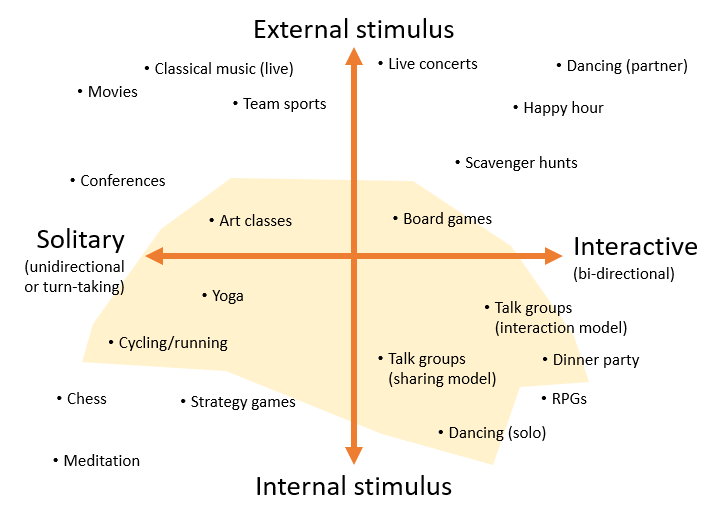
Now that the quadrant discussion is done, it’s helpful to look at where events might fall in the quadrant. Events that are towards the center of the quadrant are (likely) less intensive. As you move outwards along both axes, the events require more adherence to social rules and more sensory processing/thinking.
Please note: this is my own interpretation based on generic types of these events. How you would place events depends on how they are structured and how you experience them.

It’s worth creating your own quadrant to find out where your ‘sweet spot’ is for events. Like, the events I am happy to do most of the time fall within here the yellow blob below. For events that fall outside of this, I may have to do more advance planning and recovery afterwards to be able to participate fully or actually enjoy them.
Sequenced events
Multi-stage events may scheduled to rotate through these quadrants to allow different experiences in a single evening. Dinner and a movie may be internal-interactive then external-solitary. Stadium concert then drinks would be external solitary then external interactive. This may allow people to blow off steam from the social strictures of one quadrant in another.
If a sequence of events requires to stay in a quadrant you are uncomfortable in, then you are going to have a harder time self-regulating and enjoying yourself. For example, if you are a chatty, mobile person, then a yoga-meditation-yoga-silence retreat is going to be a rough go for you. But if it’s yoga – art class – hike – dinner party, it might be easier from certain perspectives.
It’s also worth looking to see how intense the event sequences are (the further from center, the more intense). A day of a chess tournament – classical music concert – partner dancing – RPG is going to be more likely to burnout someone than yoga – conference – informal dinner – board game.
Conclusion
I really enjoyed going through this process and just taking another look at how I might be able to understand which events I have a hard time with and which ones might be easier for me. I can’t count the number of times I have signed up for events that just aren’t for me and either bailed last minute (which isn’t nice to the event hosts and often costs me money) or gone and had a terrible time. Perhaps I can avoid some of that in the future? Or, I can do some advanced planning and actually show up at events outside my comfort zone in a way that lets me enjoy the event?
 The Friend Manual: How to make friends when you're bad at it