I started to think of friendship like a stock portfolio that can be diversified to control for risk. You’ve got high intensity friendships that are high energy cost and (potential) high return, but also hard to get and maintain, and lower intensity friendships that are require less energy and are easier to have more of, and easier to get new ones.
Friendships, like stocks, can be unstable and subject to internal or external pressures, and certain friendships may go through bad quarters, which is when it helps to have a network of friendship to pick up the slack.
This helps me to analyze how all the social activities and habits that I participate in as a big web of friendship in total, rather than trying to pin down a single group of people as friends or put too much importance on one person as my FRIEND. Rather, I have been thinking of everything in total – friends, family, acquaintances, friendly interactions with strangers, friendly coworkers, etc. – as satisfying my need for personal connection.
This is helpful to keep in mind because we often have much less control over the cadence and quality of our friendship as adults. Looking at friends as a diversified portfolio has made me more resilient to the ups and downs of friends (people get busy, people get depressed, groups disband, family vacations take priority, someone moves, someone is selling their house, the world is too much, oh look, a pandemic…you get the point).
What might this friendship portfolio look like?
This is an example of what the options for a friendship portfolio might look like based on the intensity of relationship interaction. As always, this is based on my ideas at this moment in time. If you disagree, fantastic. You’ve determined one more part of your bespoke friendship paradigm.
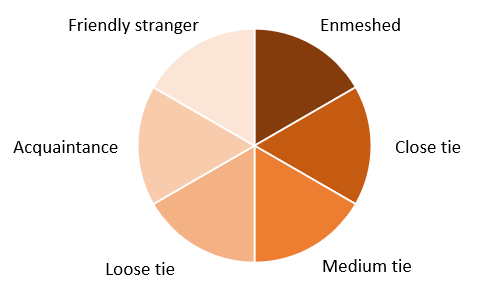
Enmeshed connections
Enmeshed connections require a high level of interaction and intensity. Enmeshed connections often preclude other connections because it takes more of a person’s social energy to maintain the enmeshed connection. People with exceptionally high social energy or highly porous personal boundaries may have many high intensity relationships in this category. Because of the high intensity, these connections may be unstable with many ups and downs or rock solid.
“Best friend” groups that are exclusionary may fall in the enmeshed category, especially if part of the social rules of the group mean that any other friendship is considered suspect (female childhood best friend groups are often designed this way – see the movie Mean Girls). Romantic relationships may perform this way in the friendship sphere if couples require that both people in the couple are invited to all events.
Strong tie connections
This type of friendship has a high level of reciprocity and intensity. The kind of people who have a continual back and forth with and high level of interaction. It requires a lot of effort and planning and sacrifice to maintain these relationships.
These connections can falter during adulthood because of the increasing demands on time, attention, and increased stress levels due to life in general. Adults with multiple sets of responsibilities may not have the bandwidth for time and intensity all the time.
Some people thrive with strong tie relationships and tend to attract other strong ties to them. Some people want strong tie connections but fail to find other who want them or tend to not put in consistent effort to maintaining them.
Medium tie connections
This type of friendship has a good amount of reciprocity and trust and consistent interactions, but interactions may occur less often, stay a bit more surface level, or revolve around activities or groups. It’s my theory that medium tie connections likely make up the majority of adult friendships in the U.S., as Americans are socialized to save strong and enmeshed relationships for their romantic sphere or for “best friends” friendships. It’s not often that adults get together to talk about “deep” subjects and be vulnerable.
Side note: As I write this, there is part of me that is objecting strenuously to having any friendship that is less than the “best” friendship, by which I mean the closest friendship with the most…uh….”points” I guess. It’s interesting to see in real time how I am socialized to feel bad if I don’t have the “closest friendship ever” for all my friendships. I think part of this exercise for me is learning that each type of friendship has it’s benefits and drawbacks which means none is necessarily better than the other.
Loose tie connections
Loose tie connections are people that you enjoy or with whom you can enact and receive friendship, but that either time restrictions or lack of inclination keep you at only meeting up by chance. You may happily invite loose tie friends to larger events, but not smaller, important events.
Loose tie friends are a good place to try and find people who may become medium tie friends.
Acquaintance
You both know each other’s names, you can make stilted small talk, but you have little friend chemistry. I think a lot of people may be loathe to call someone who is not actually a friend and acquaintance because it sounds a little antiseptic. But it’s also highly unuseful to call someone a friend and then treat them as an acquaintance because this will confuse them.
Friendly stranger
I think this is a highly underrated part of the friendship portfolio. Modern society has decided that friendly interactions between strangers in large American cities is suspect. However, it can be a lovely way to add an element of surprise to you and another’s day. I have had some delightful exchanges with people in elevators, at cash registers, in dreary, endless lines, where I have surprised someone into chuckling. Or, if it’s the best kind of interaction, then you get a glimpse of the strange inner life of another person.
And if you are short on friendships, it’s a good way to remember you are still human. There have been weeks when I haven’t spoken in person to another soul until one of these interactions. It’s also worth paying attention to whether someone else is pinging you for a tiny bit of human contact and doing your best to support that. We all need a little help sometime.
Outliers in the Portfolio
There are people in friendship portfolios that are hard to classify, partly because this is made up and completely arbitrary and partly because life is complicated. It’s up to you to figure out how these affect your portfolio in your life. In my experience, these friends confuse me a lot because I am hopeful and loyal, so when I am consistently faced with these people I always trying to to see the best impact they may have, often in spite of actual friend interactions.
Intermittent friendships
Intermittent friendships have an odd place in a friendship portfolio. They are often close tie or medium tie friends who people “click with” or have a long history with. These are the people that you may only contact or see once a year or only travel with, but you fall into an immediately deep friendship with them. However, for whatever reason you both rarely contact each other. These people may provide deep connection, but they may not contribute much to your day-to-day portfolio.
Aspirational Friend
This is someone you may have a certain type of social connection with, where you would like them to be a closer friend than they are willing or able to be. Depending on the level of disconnect between where you want them and where they are will create a level of cognitive dissonance. They can also create this dissonance by treating you in person as a medium or strong tie friend, and then declining any invitations to hang out outside of random encounters (which is loose tie or acquaintance).
Previously closer friend
Sometimes people grow apart. Life may get in the way, your friend may find another group of friends and drift away. Life may just get hard. And when people don’t have new language or mental models for different modes of friendship, they can become dissatisfied without being able to explain the reason why, leading to confusion and hurt feelings.
Passive friends
Passive friends are projected signals but without reciprocity or asynchronous reciprocity, e.g., you follow each other on social media and occasionally like or post on each other’s statuses, but never actually interact. These are people who may be “friends” that used to be closer. Or, perhaps people that are in the same social circles as you that you know their name but don’t hang out with them. Or perhaps, they are people at work that you make friends with because you are stuck together for hours on end but have no other reason to talk. They may provide “noise” to your portfolio, but little substance.
What might different portfolios look like?
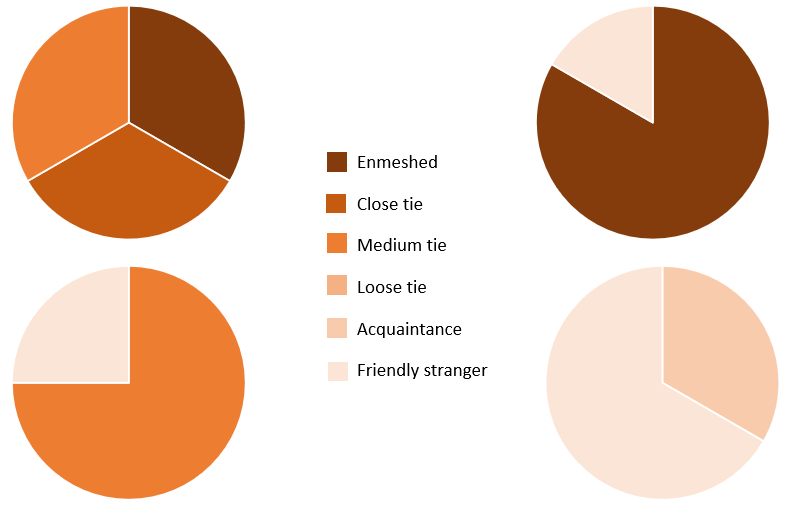
Everyone’s friendship portfolio will be different based on many factors such as the following list. It may be helpful to look at what your portfolio may be and try to extrapolate what those portfolios may be for your friends and acquaintances. Once you have looked at your own, you can opt in or out of social activities to try and balance this to your liking.
- How much friend intensity they can handle – I can have a few close friends and some medium tie, but struggle with people who want enmeshed friendships.
- How many total friends they can handle – I can’t handle a lot of friendships because I have a limit to the number of social events and structures I can navigate.
- If they are skilled at talking to new people – friends on the left side of the portfolio require this skill. I was able to develop it more after taking years of improv, but still struggle when there are novel or strict social conventions around interactions.
- Enmeshed social connections take most of their bandwidth – people with young children or extensive home responsibilities (e.g., elder care, family crisis) or new/escalated relationships. I’m pretty sure my dogs qualify as my enmeshed social connections.
- Low bandwidth – life has too many problems/responsibilities that are taking too much time or energy, or the person has a low social drive and needs to be selective about social effort.
- External restrictions – having friendships is about offering and receiving offers of social connection and mutually acting on those offers. If few offers are given and/or reciprocated, then a person may have a limited portfolio.
Why is this important?
I’ve been looking at a friendship portfolio as a way to see social connections over a longer timeline. I can often fall into the trap of viewing my social connections in a really short timeline, which can be more isolating. For example, if I suddenly decide I want to go out for dinner and text my list of friends and half don’t respond and everyone else is busy, I can label that moment in time as “I don’t have any friends.” Because in that moment I have defined “friends” as people who will respond to me right now. And the more times this happens, the more I get the same reinforcement that “I don’t have friends.”
But if I look at it from a meta perspective – say over a week if I am more social or a month if I am less social, then this instance reads “I don’t have any friends that are available for dinner right now. But I went together with this group to dinner on Monday, and visited museums with an Meetup on Sunday, and I had some good time chatting with people at work today….” In this case, I am still eating dinner alone, and I may still want to hang out with people, but my feelings about my friends and my place in the world are more right-sized. I may even choose to go pick up some food and be a little chatty with the hostess just to get a hit of socializing with a friendly stranger. And maybe I will set up a dinner for next week at the same time so that I can get socializing when I want it.
 The Friend Manual: How to make friends when you're bad at it