Yay! Another quadrants post.
For fun, I have set up horizontal and vertical axes to reason out how activities may cause stress in the body by either requiring or inhibiting bodily movement.
Why explore this?
People who struggle with movement inhibition, may experience more stress at events that have a large number of social rules (mores) around stillness or proscribed movements. Some people need to move often for all sorts of reasons. They may simply need to fidget, or have pain/circulation issues, or use movement to regulate their nervous systems. Everyone has an upper threshold of too much movement, above which they are too stimulated and need to slow down, and a lower threshold, below which, they will need to perform movements to regulate discomfort (think of trying to take a nap when you’re really excited about something).
People who struggle with body movement restrictions may initially experience mainly body issues, but after hitting their threshold may begin to experience escalating stress symptoms and cognitive distress which can lead to behavior that violates social norms.
For people who prefer sitting still or who find movement or physical coordination in social situations challenging, the opposite occurs, and they may find themselves distressed if social mores require movement or audience participation above their threshold.
And then some people may consistently find themselves add odd with social mores, e.g., if it’s quiet, then they need to move, if it’s noisy, they freeze like deer in headlights.
I’m pretty sure that I’ve met people that rarely struggle with existing in any space, but they have been few and far between.
The Body Movement Graph
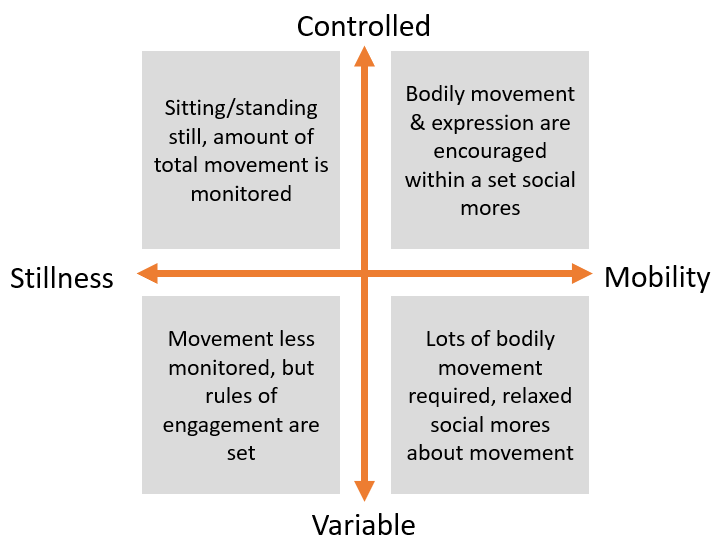
Here is the basic setup for the discussion below. On the vertical axis, we have controlled movement at the top and variable movement at the bottom. On the horizontal axis, we have stillness to the left and mobility to the right.

Controlled-variable axis
This vertical axis indicates a gradient between activities the require controlled movement to activities that variable movement. Controlled movement may be stillness (sitting in a theater seat) or standing in a single location (networking events) or movement that is limited such as running or road cycling (repetitive movements going in a forward direction). Variable movements allow people to move around at will. The further down you go on this axis, the more varieties of movement are allowed including more limbs, for example, wandering around a museum allows some variability, but interpretive dance allows much more.
Stillness-mobility axis
The horizontal axis indicates a gradient of activities that require stillness or restricted movement on the left to activities that require mobility and movement on the right. Stillness and restricted movement are usually accompanied by restrictions on noise as well. For example, on the far side of stillness, you can think of a classical music concert which requires the audience to be absolutely silent except for approved instances of hand-clapping-only applause. Closer to the center, you may find events that still require you to sit still, but allow more audience participation, such as a comedy club.
Events with high mobility requires attendees to keep moving or to continually interact with others. Sports like soccer or volleyball require constant movement, as do scavenger hunts. Closer to the center, you may find networking events where people are expected to continually interact and circulate through groups.
And now…onto the quadrants!
Every dual axis model of social sciences is primed for quadrant definitions. Quadrants are such a great way to organize thoughts around variables and to look for how one variable may influence another to find useful patterns.
The quadrants below are discussed in clock-wise order from the top-left.
Controlled-stillness
Events that show up in the controlled-stillness quadrant are often set up to experience something, such as a movie, lecture, or a stage play. They make it so you can take in a lot of information in a short amount of time, and are meant to be immersive. If the event is not something to capture your attention that day, or you are someone who doesn’t connect with these types of events, they can be really painful to sit through. Because they need a controlled environment, they also tend to have really strict rules about entering and exiting the space, restricting eating/drinking, breathing too loudly, singing under your breath (thanks crazy dude who sat next to me and sang the whole way through Pippen), too much movement in your chair, etc.
Controlled-stillness events often require a high level of visual/auditory information processing. People who are naturally inclined to this will likely thrive in these events.
How does this help? This quadrant holds some of my favorite types of events, but they further out on the diagonal it goes, the more stressful the event is for me. Looking at this explains why I am always very reluctant to go to a movie theater. I’d like to watch new movies on a large screen, but I find sitting still for two straight hours painful (mentally and physically).
Controlled-mobility
Events that show up in the controlled-mobility quadrant may have an high level of social interaction coupled with an expectation of moving around and mingling or immersive participation. Escape rooms, gallery openings would fall into these. Controlled-mobility events might also require attendees to stay “on task” with the event topic or theme, which can be difficult for people with short attention spans. And they may require following more complex, higher stakes social rules, such as those found in wedding receptions and networking events.
Controlled-mobility events often require complex processing of social rules and inputs. People who do this naturally will likely thrive in these events.
How does this help? I was surprised that this quadrant seemed to be the one I had the most trouble with when reflecting on the quadrants. In my interpretation of this, controlled-mobility seemed to require event goers to abide by narrower social rules and be more comfortable socializing per the event rules. I would put events like wedding receptions and professional networking events in this quadrant. For myself, if I was wanted to/was required to attend an event in this quadrant, I might do a lot of planning beforehand to make sure I was ready to attend and would plan to leave early, if possible.
Variable-mobility
Events that show up in the variable-mobility quadrant tend to have more stimulus because they usually allow and/or require interaction with both the space and the people. This may be a relief to people who struggle with movement inhibition and also may exceed the threshold of someone who is naturally still or who is shy.
People who are shy or socially awkward may find the interactivity in these events overwhelming or disingenuous because the manner or intensity of enthusiasm or the level of movement and attention is not natural to them.
Variable-mobility events require more decision-making about body position, gestures, social reciprocation, and location. People with intuitive understanding of this will thrive in these events.
How does this help? If you are someone that thrives on interactivity and being able to influence your environment, then this may be your quadrant. I am more happy to attend events like these when I have more energy reserves, however, for me they often have an amount of social pressure that exceeds my threshold. I often want to attend them, but tend to get overwhelmed when I am there, especially if the event is large.
Variable-stillness
Events in this quadrant tend to involve a high level internal information processing that is sequential. Variable-stillness events may require you to follow a conversation or the rules of a board game. The goal of this is to be in a choose your own adventure-style immersive event. For people that struggle with social rules, variable stillness events (often seated) can remove some of the stress involved in trying to follow social rules while also participating in the event. These events are often more successful when they are facilitated by an event host.
How does this help? This is my favorite quadrant because there are some social rules, but they are less formal and require less monitoring of body movements and vocal inflection. In my opinion, It also requires less enthusiasm and social confidence in body movements and interactivity than the variable-mobility quadrant.
Where do events fall on this quadrant?
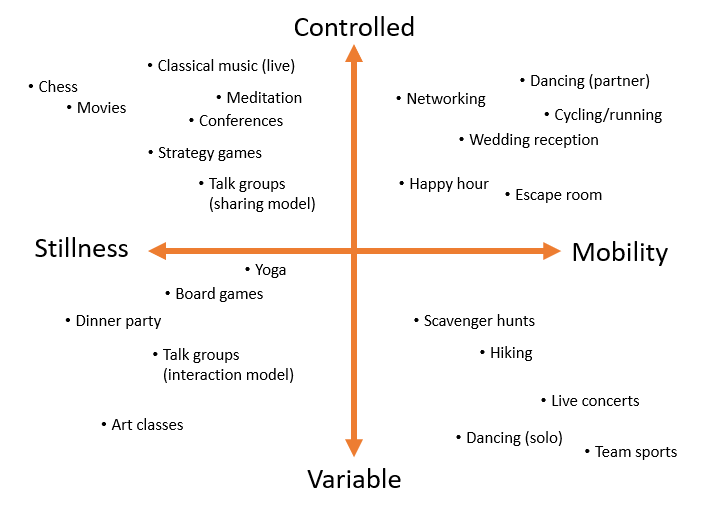
Now that the quadrant discussion is done, it’s helpful to look at where events might fall in the quadrant. Events that are towards the center of the quadrant are (likely) less intensive. As you move outwards along both axes, the events require more adherence to social rules and more sensory processing/thinking.
I didn’t think too hard about how I placed these events because they are based on my own experience (which will differ from yours) and are always subject to the event itself. For example, a large, formal dinner part may required fully controlled stillness and and a small, rowdy dinner part with friends may be closer to the center and lower on the variable axis. Additionally, you may never attend a dinner party if you only go rick climbing with friends and then eat around a campfire.
Please note: this is my own interpretation based on generic types of social events. Which events you would include and how you would place events depends on how they are structured and how you experience them.
A little bit of thinking
Going through this process is making me think of all the events I like to attend and why/when they are easier/harder for me to attend. For events I want to attend, but that fall into areas / configurations that are harder for me to attend, I think I can do advanced planning or more careful event choices to make the events more successful for me.
It’s also making me blame myself less for instinctively avoiding certain events, like movies in theaters, because it’s stressful. But it also makes me curious if I should try attending an opening night showing for an action movie just to see if a rowdier crowd may make me like sitting in a theater more.
 The Friend Manual: How to make friends when you're bad at it