I find it really helpful to think of complicated problems (such as loneliness) in terms of simple propositional logic. So, I’ll walk you through why the opposite of lonely is actually not-lonely at a very high level.
Disclaimer, I am not a math person, so this post may be a bit dodgy. But if you like the idea of propositional logic, check out the book Godel, Escher, and Bach for a whole mind-bending experience straight outta 1979.
What is loneliness?
My first step is always a definition (because I can’t fix something without understanding it’s components). I’m going to define loneliness as:
The unfulfilled desire for bespoke, positive, reciprocal interaction with friendly, sentient creatures, most often humans.
The above definition indicates several things:
- Unfulfilled desire – a gap between what I require and what is happening in each of the sub-categories below (each category can have a 100% of a desirable outcome that I can strive for, but maybe 70% suffices)
- Bespoke – specific to me and the other people interacting (generic small talk is not bespoke)
- Positive – total interactions have a net positive effect for me (if I have a net negative, my loneliness will increase)
- Reciprocal – I need to be providing and receiving input, care, and emotions with others who are providing and receiving
- Interaction – timely back and forth multiple times
- Friendly – someone who I trust within the situation / bounds of friendship (think of this as someone who is a potential ally, not just smiles)
- Sentience – in order to abate loneliness, I need interaction with alive beings that acknowledge me as an individual. (watching my favorite tv show won’t work, but playing with my dogs does)
- Humans – yup, as a human, I need human interaction
When I am lonely, I am missing some combination/percentage of the components. I don’t need every component in every interaction to become not-lonely, but I do need all of the components on a regular basis.
How do I make myself not-lonely?
I don’t like being lonely. It makes me feel bad. So, how do I manage my life and emotions to make myself not lonely?
Lonely and not-lonely
Here, we have loneliness (which was just defined above).

When trying to remedy loneliness I often make the same mistake in thinking that to not be lonely anymore, I have to replace it with another positive emotion because the opposite of lonely is happy/lonely/fulfilled/etc.
For example, “to not be lonely, I have to be happy” — or to put it another way “happy people aren’t lonely, therefore when I am happy I will not be lonely”.
I also fall into the trap of thinking that loneliness is a semi-permanent state and, once it is triggered, it remains my base state until I have disproven it (like a light switch turned off, I remain in a dark room until it is turned back on). In order to disprove the loneliness (turn the light back on) I have to be continually fulfilled or ecstatic. And to further complicate things, when I have determined I am “lonely” I constantly look for confirmation that I am indeed lonely, and am being excluded from things (yay confirmation bias!).
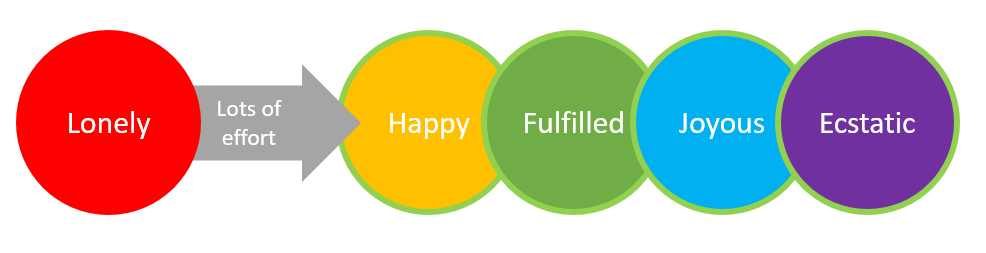
This is where the propositional logic part comes in. In propositional logic, the way to define the opposite of something is to put “not” in front of it. The opposite of X is not-X. And every sub-part that defines X is also opposite.
Therefore, the opposite of lonely is “not-lonely”.
In order to become not-lonely I need to change the first bullet in the loneliness definition from “the unfulfilled desire” to the “fulfilled desire”. This changes the whole definition because I nested the rest of the definition within the first bullet (which was a negative…a not-fulfilled desire).
And, the cool part of how I crafted the definition of loneliness is that it is all written in positive terms. They all indicate the presence of things, which are (mostly) measurable, rather than the absence of things, which is less measurable and less under my control.
Side note: It’s tempting to think of not-lonely as the same as “contentment”, but doing so undermines the binary thinking pattern which supports behavior change. If I made a breakout of the definition of “contentment” the list would not map 1:1 in opposition to the “lonely” definition and I would end up with certain factors of my loneliness not addressed.
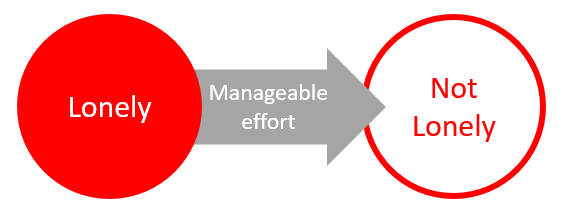
And now that I have not-lonely as a goal, I have an action item list for types of interactions that I need to go from lonely to not-lonely.
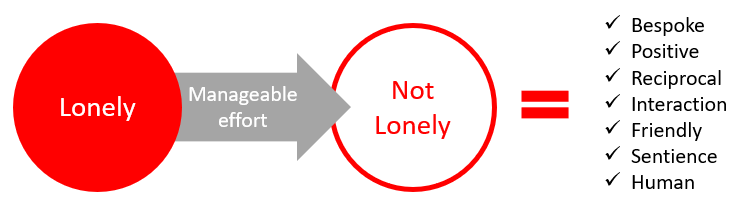
I simply need to go down the bullet list and see what is missing in my life, what exists but is lacking in intensity or recurrence, and what is already present that I may be discounting because I mislabeled or misunderstood it. This is right-sizing my loneliness. Once I have right-sized it, I can go ahead and use the radar graphs to create a loneliness abatement plan (I gotta be honest, sometimes I do talk like this in real life. It’s a quirk).
 The Friend Manual: How to make friends when you're bad at it