For people that struggle with either attending events or with understanding why other people struggle to attend events, I’d like to pose this stressor model as a useful guide.
People tend to use a simplified model to think of going to an event or even something as simple as a hangout* with friends. It’ll often go like this “I get an invite, I go, we hangout, I go home.” This is great as long as it all falls easily within your social and physical abilities.
For other people, a hangout is much more complicated.
*I’m using the word hangout instead of event because a small hangout can be just as complicated as a formal event for people who struggle with friendship.
Stages of a hangout
These are my stages of a hangout. Each of these can have multiple stressors for people with social anxiety or overwhelm. Even people who generally enjoy events can underestimate the impact of stages that they generally gloss over. I’ll do a quick overview of this and then make separate posts for certain stages later.
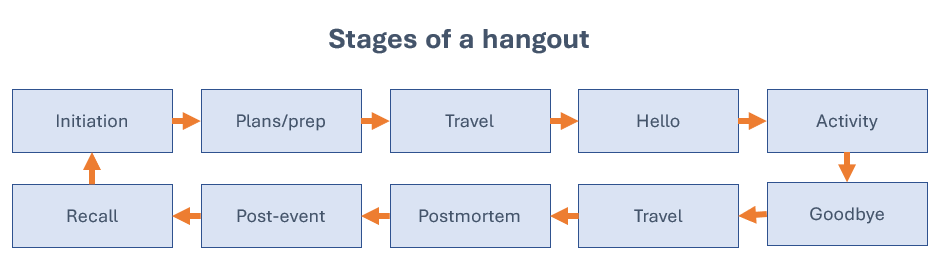
Initiation
One person suggests the idea for a hangout to another person/people and they accept the proposal, reject the proposal, or provide a counter-proposal.
Plans & preparation
Once the proposal is set, then one or more people in the group determine the location, timing, and base rules of the hangout (by determining the type of event). Whoever is hosting/planning the event has extra duties.
Travel to the event
Each person in the hangout must arrive at the designated location, on time, with the required tools and mindset to participate. People who are hosting the event are in a holding pattern during this stage.
Saying “hello”
Each person must navigate the switch from individual to group and group to larger group. Events with more than two people must do this multiple times.
Performing the activity
Each person must abide by the activity rules and social rules throughout the hangout.
Saying “goodbye”
Each person must navigate the switch from larger groups to smaller groups and group to individual without causing social harm to themselves and others.
Travel from the event
Each person must navigate through time and space to return to point of origin or arrive at the next event at the designated time/place.
Doing a postmortem
Individuals will run through the interactions during the event and assess whether they adhered to social rules correctly and if they achieved their desired outcome.
Post-event activities
Individuals that wish to continue social interactions with those from the event may contact each other via various means to test receptivity and maintain social connections until the next initiation.
Recalling the event
Each person will have memories encoded about the event that they may access to trigger an initiation of a similar event or similar event attendance based on postmortem and post-event activities.
Initiating or accepting initiation to the next event
Prior to taking action to initiate a new event, the initiator will be influenced by the previous experience of initiating and hosting similar events in the past.
Prior to accepting a new event initiation, the acceptor will access event recall to assist in deciding whether to accept.
Breaks
In between each stage, there’s an opportunity for breaks. Check out the breaks post here.
 The Friend Manual: How to make friends when you're bad at it