And here’s where we get to the ‘why’ of all these memory posts. And also, this post may indicate the depths of my neuroticism, but to be fair, this whole blog is like this.
What is memory recall?
Memory recall is the surfacing of memories in response to stimuli.
Recall can be subconscious or intentional or a mix of both.
Why do we care about memory recall?
Recall is important is because memory shapes your decision-making. We make decisions based on our memories + information we have access to at the time.
Memory recall is integral to the continuation and curation of social interactions (i.e., who you seek out and invest in friendship with).
When I tried to write this all out, I went down a million rabbit holes and got stuck on this post for months, so I chose to illustrate the importance of my memory recall with cartoons. Your memory experience may be completely different. Please enjoy!
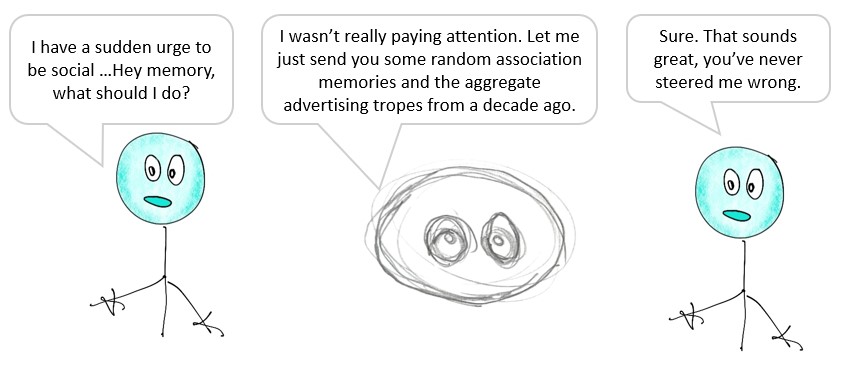
Memory recall at random
Here’s what my memory recall does when it’s running around completely unsupervised, like a toddler. As previously noted, my memory is an ass.
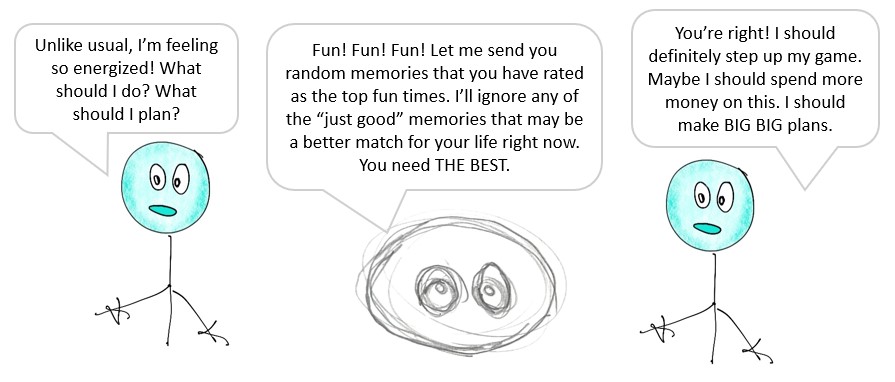
Memory recall triggered when too excited
When I am amped up, my memory likes to cherry pick things and ignore consequences. It also is more subject to things embedded in memories like advertising and social status. It likes to search out expensive things or times I threw caution to the wind. Recklessness is a bonus.
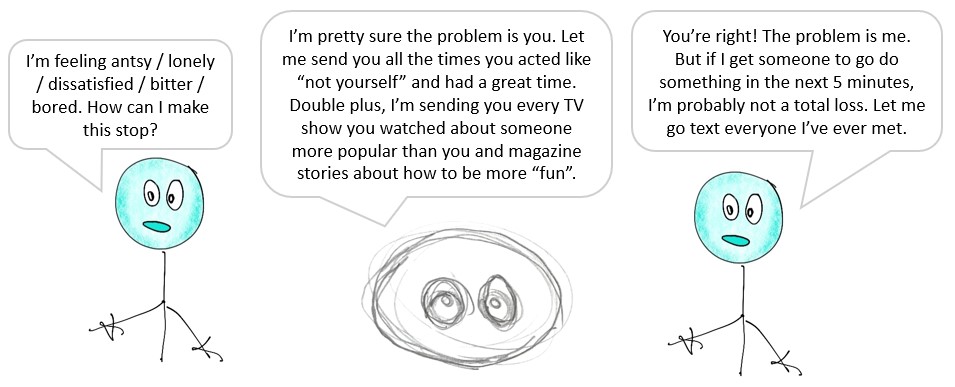
Recall triggered by negative things
Sometimes I feel bad and I try to alleviate feeling bad by changing my situation. This is fine, but where I run into trouble is when I try to change my situation too much or too fast.
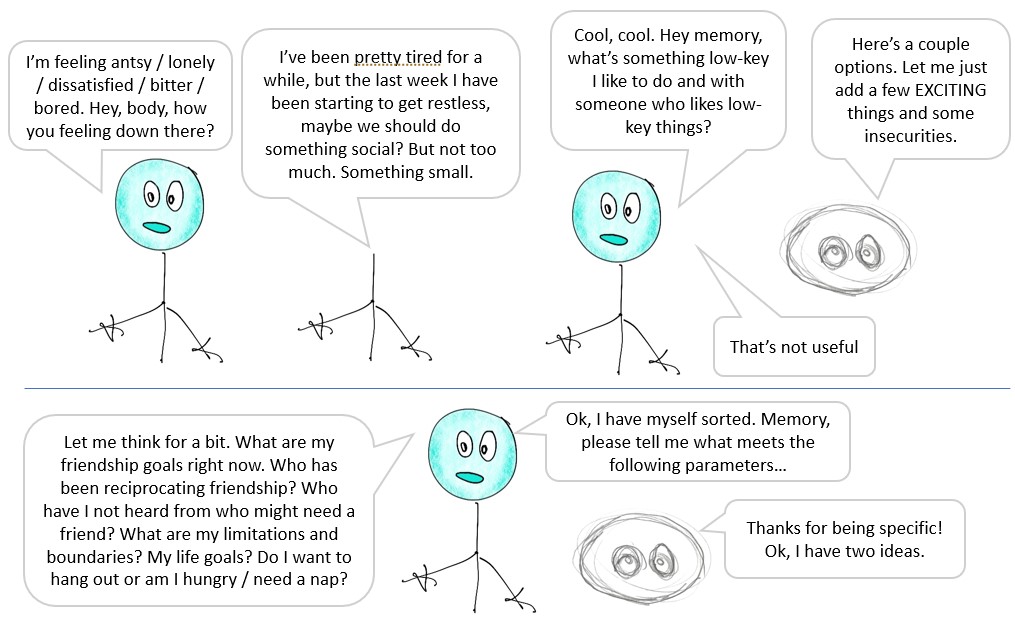
Changing to intentional recall
Instead of relying on random recall, I think there’s a different scenario where I am intentional about responding to stimuli. Regardless of whether the stimuli is good or bad, I can take the time to evaluate what I really want instead of going off half-cocked and feeling bad when there is misalignment or failure.
Why is this important?
Oh gosh, this last one sounds like a lot of work. But, when you’re bad at things, you have to work more at them, right? If I am unhappy with my situation, I have opportunities to change it.
Perhaps this is something that can become second nature in time.
Appendix A: Memory Triggers
Here is one of the rabbit holes I got stuck in. Read at your own risk!
I thought it was interesting to think of the different types of triggers that cause me to access memory and make decisions about creating and/or attending social events. For all of these, memory helps me choose (1) which people to try and connect with and (2) the type of event I want to attend.
Here are the triggers:
- A sensory input triggers the surfacing of a memory, which, if positive enough, will induce me to try to recreate that feeling with that person/group (e.g., a picture from a fun night out)
- A sensory input triggers induces guilt or a negative emotion that triggers me to act to reduce the negative feeling (e.g., a text from a friend I am avoiding)
- A positive emotion or body state (e.g., energized) leads me to try to extend the positive emotion or schedule the same emotion in the future
- A negative emotion or body state (e.g., restless) leads me to try to negate the emotion by enacting a previously enjoyable situation, e.g., text a friend – side note: advertising is excellent at triggering loneliness, which would fall into this category
- A sensory input, emotion, or body state triggers an undesirable state, but accessing memories doesn’t surface an acceptable solution and the person chooses something entirely novel. Side note: If I only choose novelty every time, then they will never make friends because friendship requires repeated exposure. Need a solid grounding for this – this is something I just figured out.
For reference, here are the links for this post series (1) memory inaccuracy, (2) memory metadata, (2.5) sidebar about how my memory is an ass, (3) memory encoding and drift.
 The Friend Manual: How to make friends when you're bad at it