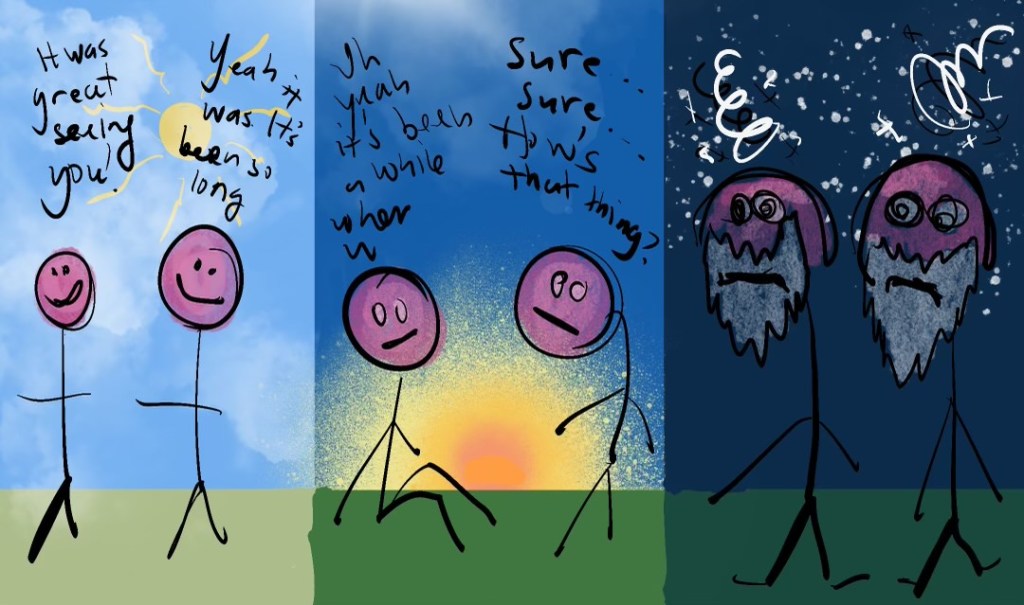
I’ve been thinking about the complicated dance of reciprocity that’s required to off ramp out of a conversation. We’ve all been in that painful conversation that we can’t seem to end. So, here’s my explanation of why this happens.
These are the required steps to end a conversation between person #1 (P1) and person #2 (P2) in a reciprocal interaction (back and forth/taking turns conversation):
- P1: Indicate intent to exit with opportunity to extend
- P2: Reciprocate intent to exit
- P1: Accept conclusion and say “goodbye comment”
- P2: Accept conclusion and say “goodbye comment”
- P1 and/or P2: Actually leave
*Skilled conversationalists can combine steps 1, 3, and 5 in a way that P2 thanks them for it. People with a deadline can also do this with impunity.
A More Detailed Breakdown
For this post, I’ll set up a little scenario with P1 being Margo and P2 being Reggie.
Margo and Reggie have been in a conversation for a while and they’re running out of things to say, but neither of them has indicated that they have to be somewhere soon for schedule reasons. In fact, they have both said they have no plans for today. So, in this scenario, none of them have a good out even though the conversation is limping along and they are both checking their watches.
So, they should be able to end their conversation easily, right? Hahaha not today! These types of conversations are sometimes the hardest to end.
Step 1: Exit with opportunity to extend
When the conversation is concluding, one person must take the initiative to propose exiting the conversation. This is the first hurdle, if both people consider it “not polite” to end a conversation early, then they may end up in one that far exceeds the interesting content and positive feelings.
When (P1) Margo is ready to end the conversation, she needs to say something that indicates that she plans on exiting the conversation, and that also indicates that this is (P2) Reggie’s opportunity to extend the conversation if he has more to say. This allows Reggie to remember that, yes, actually, he meant to ask Margo if she wanted to go to the museum next weekend.
It also serves to buffer the transition and keep both people feeling heard in the conversation. I believe everyone has felt the discomfort from when they have exited a conversation too fast or when someone has abruptly ended a conversation with them.
Exit gambits include:
- “Well, this has been great talking, I think I am going to get going now.”
- “Thanks so much for sharing that. I’ve got some stuff I’ve got to finish.”
- “It was nice meeting you. Can I get your email/text so I can send you that info?”
While writing each of these, I realized that the opportunity to extend is more often than not just a pause in the conversation instead of explicitly stated. I don’t know if people often say something to fully close out a conversation unless they have been having an intense discussion or argument, e.g., “are we good now??” I guess I need to go pay attention.
Stay tuned for part 2!
 The Friend Manual: How to make friends when you're bad at it