Here’s the second part of the ending the conversation series, see part 1 here.
First, let’s talk about this darling image above, the Exit Gambit Decision Matrix. This decision matrix shows all the ways two people can choose to respond to an exit gambit. Person 1 (P1) can say yes or no (Y/N) and Person 2 (P2) can say yes or no (Y/N) – yes indicates they would like to accept the gambit and leave the conversation, no is the opposite. When you map them in a box, P1’s response is on the left of the square and P2’s is on the right. This is a standard math/science thing.
Now, if you assume that both people must accept the exit gambit to leave the conversation without being rude, then the only scenario in which you can leave is the YY box. Which means, that is is mathematically harder to leave a conversation then to stay in it endlessly…until you grow a full beard and die of malnutrition.
It’s a bit daunting, eh?
Now, on to step 2 of the process (reposted for reminder):
- P1: Indicate intent to exit with opportunity to extend
- P2: Reciprocate intent to exit
- P1: Accept conclusion and say “goodbye comment”
- P2: Accept conclusion and say “goodbye comment”
- P1 and/or P2: Actually leave
Step 2: Reciprocate intent to exit
Okay, so the next step after someone indicates their intent to exit requires two parts:
a) P2 must understand and accept that P1 has made an exit gambit, which suggests ending the interaction
b) P2 must decide whether to reciprocate the exit gambit or to extend the conversation by introducing more information or asking a question
- If P2 decides to reciprocate, then they will need to explicitly indicate they also plan to leave the conversation.
- If P2 decides to extend, then they will need to introduce further information to extend conversation duration.
Potential failures with (a) include:
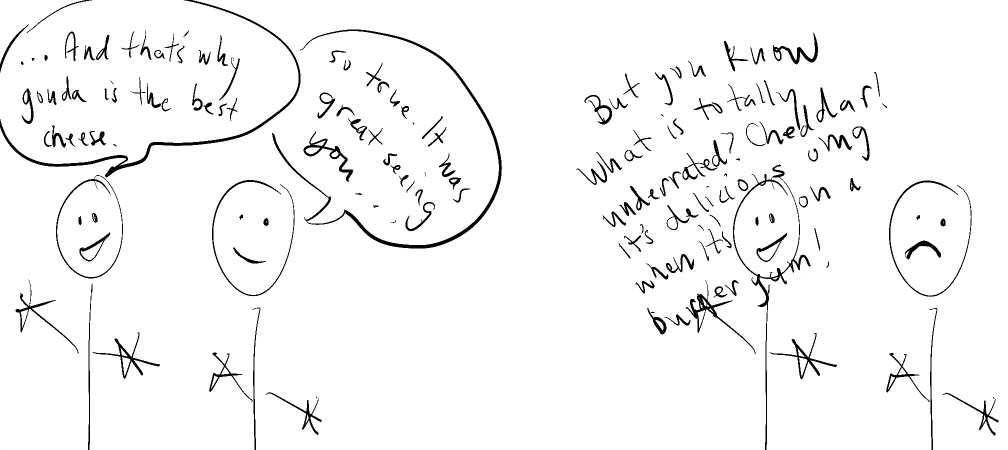
Failure to recognize: If P1’s exit gambit is not explicit enough, then P2 may not even recognize that P1 would like to conclude the conversation and may accidentally extend the conversation even if they would prefer to exit.
Failure to accept: P2 may choose to ignore P1’s exit gambits if P2 would like to continue conversing indefinitely. By not accepting gambits to leave, it will force P1 to escalate leaving attempts until escape velocity is achieved. In this case, P2 may not even acknowledge that P1 has made exit gambits which can make things even more awkward.
Potential failures wit h (b) include:
Lack of clarity: If both P1 and P2 fail to be explicit in initiating the end of the conversation, then neither person can accept the exit gambit and advance to the next stage of exiting a conversation.
Accidental negation cycle: If P2 accepts the exit gambit and reciprocates, and then adds more information to the conversation, then they have effectively negated the entire process and you’re back at step one. Lots of people will do both of these (including me!), which is when you get stuck in the loop of endless convos.
Why is this so hard?
Usually I have some sort of pithy statement or summary to add, but, really, this all seems overly complicated. Why can’t I just say “I’m bored now, byeee” and run away in a loping gallop or disappear into a puff of smoke?
Stay tuned for step 3!
 The Friend Manual: How to make friends when you're bad at it