Disclaimer, I wrote the first draft of this post in May and didn’t get around to polishing it up until just now. This was before my dog died. It feels…wrong…to takes references to him out. But I am glad this helped me focus more on him in what turned out to be his last months.
A month ago, I had a conundrum.
I was feeling lonely, but I was also hanging out with people.
I knew I was talking to people and had some friends that I hung out with occasionally. And even on days when I had good conversations, I felt alone. And not the simple kind of loneliness, the big kind of loneliness.
I knew that I was having regular, positive interactions with people I liked.
I knew that I was lonely.
But…why was I lonely if I wasn’t alone?
Where was the disconnect?
So, in typical “me” fashion, I created an experiment.
The Setup
This led me to create an experiment that actually worked quite well. It’s not a forever fix, because I think this sort of cognitive dissonance is something that is inherent to my brain. I did it for a month, and about a week after I stopped doing it, I found myself backsliding and had to restart.
Here are the requirements I chose to inform my experiment design:
- Needs to be visual – I’m more visual when it comes to problem solving
- Needs data to track – my short-term memory is not trustworthy and I need PROOF to contend with it (see My Memory is an Ass)
- Needs to be <10 mins – I tend to overcomplicate things, so I need something simple that uses techniques I already like doing
- Needs to be simple – I was burnt out, so it needs to be easy
- Needs to incorporate things I like – this lowers the barrier for entry
- Needs to be physical/tactile – I wanted it to be non-digital, so I could incorporate something tactile. I was having trouble with something very amorphous, so making it physical helps.
So, what I needed to do was to analyze my loneliness using concrete, visual cues that would let me not worry about understanding whether I was lonely or not. I could instead look at the data and reverse engineer whether I was lonely based on existing factors.
Finding the Right Materials
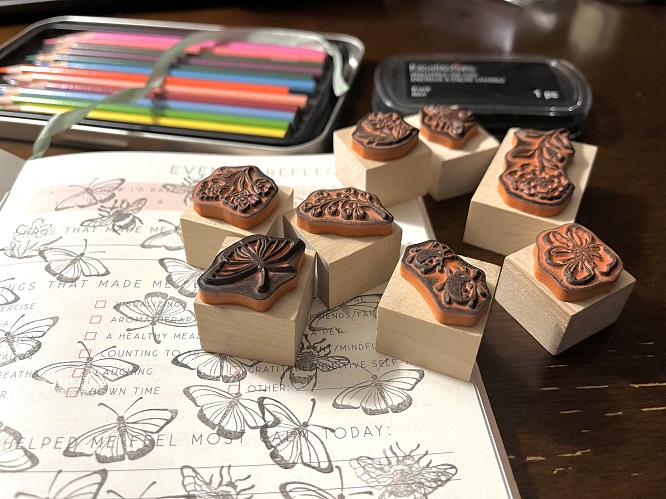
I love stamps. This may seem like a digression, but it’s not. I wandered all over Michael’s looking for some combination of art supplies that would be something that I would find joyful and engaging enough to keep doing it. I tried finding stickers and markers and journals that didn’t quite fit the bill. And I tried thinking about symbolism and stretching metaphors and all the things. After about an hour, I ended up with a pack of stamps that had insects and flowers, a black ink pad, colored pencils, and a journal.
The journal that had day and night prompts for things like how many hours I slept and what type of stressors I expected during the day and asked me to plan my day. In the evening, I was supposed to check in and do other things. But mainly I just used the evening check in to do the loneliness tracking. Or should I say anti-loneliness, or even better – social connection tracking.
Finding the Right Method
This all took a little bit of experimentation. But here’s the method that I came up with because it works for me.
At the end of every day, I added a butterfly stamp to my journal for each interaction I had with someone where we treat each other like unique human beings.

Stamps for one day. Names not shown 🙂
I get a stamp for the few sentence conversation in an elevator. I get a stamp for an interaction on text message. I get a stamp for a two-hour conversation with someone. If it’s a bad interaction, the butterfly goes upside down (surprisingly few of those!). I decided that all these stamps would be equal because of the friendship portfolio. I need to round out my interactions with happenstance meetings of strangers, good friends and everyone in between. I also added a stamp each day for both of my dogs because they are my roomies/family/best friends.
Now, for each stamp, I write a name next to it for the interaction. If I don’t know the name, then “nice elevator lady” will suffice. Then I go through and color each of the butterflies while remembering the interaction in detail.
My stamp collection also had a lovely bee stamp. I started using this to indicate when I went out and did something social. I tend to be a homebody, and need to balance the need for external interaction with the need to stay home. I added two bees for working in the office, one for AM and one for PM. So, I started adding bees to my report out at the end of the night.
Next, I decided I needed a stamp for when I had a really good conversation because I was starting to feel that a lot of my interactions were a bit surface-level. For that I added the biggest stamp in my collection, a big flower.
Occasionally I experimented with another stamp for when I went outside and appreciated the outdoors, and some other things. But the three main ones are social butterfly, busy bee, and chatty rose.
What happened next?
As I was recording my first week, I started noticing that I had way more interactions than I had expected. And I started to get an odd inkling that I had figured out what was going wrong with the interface between me and my life and my loneliness.
To confirm it, I did a summary page for each week. I would count up all the butterflies, bees and roses, and I would stamp them on a two page layout to see them in aggregate. And….there were so many.

Some days, without even trying, I’d end up with 12-14 interactions, which, for a devout introvert is a LOT. And when I aggregated them on Saturday morning, I sat there and was stunned to think that maybe I wasn’t lonely. Maybe I was just tired. And a little burnt out. And maybe I was just running scripts that say “if I am alone on the weekends – or- god forbid, Friday night, then I am a sad sack pity of a party.“
Another thing I noticed while coloring in all my butterflies was that I just wasn’t paying enough attention to my dogs. I was definitely feeding them and playing with them and walking them. But I wasn’t spending much of that time focused solely on them. I was listening to a podcast or watching tv or any other number of things. I needed to take more time to actually look at them. Why was I discounting my dogs? Why was it so hard to remember to give them butterflies at the end of the day. I was definitely taking them for granted.
Tracking these interactions also convinced me to make a little more effort while interacting with people to make each connection just a tiny bit special – it was a tiny bit of gamification. How can I treat this person as a distinct human in the next 5 seconds? Like when I call helpline services at major companies, sometimes I’ll make jokes with people and have a single serving friend. Or I’ll just be authentic and just call things out “I’m sorry that I’m frustrated and I know it’s not your fault.” Or just share a moment of joy “have you been outside today? The sunshine’s good enough to drink.”
The bees helped me to see when I was overextending myself.
The roses helped me understand when I had a deeper conversation.
Why does the Butterfly Journal work for me?
I am all about patterns and visualizations. This journal gave me the means and methods to create something that allowed me to understand a pattern in my life and take steps to changed it.
It takes a while to see the pattern. And then it takes longer to feel the pattern. And it takes even longer to learn the lessons that the patterns teach.
The things that this experiment allowed me to do:
- Properly categorize social interactions in a way that was meaningful for me
- Use my preferred sensory method to deliver factual information – I want to see my facts
- Adapt the approach as I learned new things about myself and my life
- Choose a method that I already inherently enjoyed (Stamps! Coloring! Fast!)
- It didn’t require changing anything in my life until I had some concrete information to look at. And it turned out I wasn’t lonely all the time, I was actually probably overstimulated, so I cut back on some interactions and leaned into some other ones.
Plus. It’s pretty.
 The Friend Manual: How to make friends when you're bad at it