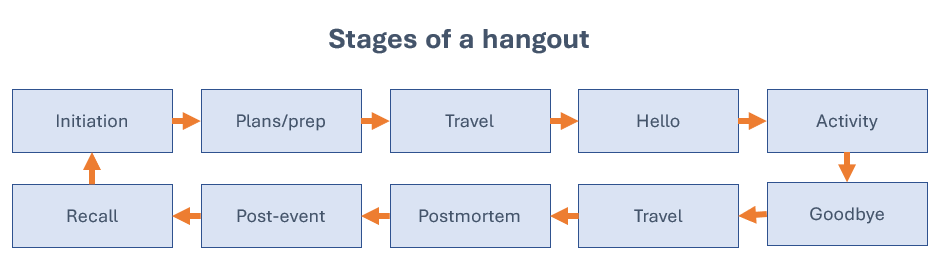
I’m finally back to the first stage of the diagram of an event…initiation!
What is an “Initiation”?
Initiation in this context is when one person asks another person to do something and the request details are explicitly accepted by all parties. It sounds so simple, right?
Well, there’s nothing that’s simple that I can’t make incredibly complex. So, let’s have a go at it.
So, what constitutes an initiation ask? An initiation ask must have at least one of these details to be considered an ask.
- Date or range of dates*
- Time of day (e.g., afternoon or 2pm)*
- Place
- Activity
- Duration
- Number of people
- Specific people
Please note: for my purposes, one of the time bound variables (marked with an asterisk*) must be decided on in the initiation stage for it to kickoff the “Stages of a Hangout” workflow.
What constitutes an initiation acceptance? Once the initiator provides the initiation ask details, then the ask itself is up for either acceptance, denial or negotiation. When the details are set, then the initiator AND the receiver must both explicitly agree to the finalized details. Enthusiastic consent in all things!
When the details of the event are accepted by all parties, then they will move on to the next stage of the event: Plans/Prep.
What is not an “initiation”?
There are some times when something may seem like an initiation (or not), but it’s really not (or is). This is where people who are bad at making friends can get caught up. I may think that I am or I am not being invited to things based on hazy social cues. I may take general social lubrication statements such as “we should hang out some time” as genuine indication of interest to hang out, when most of the time, it’s just something people say when they’re caught up in a good mood for a second or just experienced an awkward pause. Or, I may not register pre-initiation behaviors, such as discussing specific events coming up as a bid to try and find someone to do an activity with.
This is why I want to specify that a time-bound variable has to be included to make it an initiation ask. Without that time bound variable, the ask remains frustrating and less-than-useful domain of the purely hypothetical and/or is easily misconstrued.
Social Lubrication Statements
For fun, here are some general social lubrication statements (statements that are said to keep conversation going, but aren’t necessarily signaling intent):
- We should hang out some time
- Just come on by anytime
- Maybe I’ll see you there
- That sounds really interesting
- I wish I could go do that
Pre-initiation behaviors
Pre-initiation behaviors are when I am trying to see if another person has interest in an activity. What makes it doubly confusing is that I also use pre-initiation behaviors to try and figure out whether I want to hang out with that person in that context. This can be confusing when someone does this because they may change their mind in the middle and it sounds like you’re going to get the ask, but you may not get it.
Additionally, you may think that someone is performing pre-initiation behaviors because they seem really interested in what you are talking about, but what they’re really doing is getting details so they can ask another person to go do the thing without you. This is often not malicious, but it can hurt.
- Asks about common interests
- Discussing details of a specific event
- General chats and texts to test receptivity and reciprocation
Serendipity & general or targeted obliviousness
Here are some random things that popped up in my head when thinking about initiations that are useful to know are not initiations. For good or ill, I’m going to just drop them here.
- Making an initiation ask and receiving no explicit acceptance – or responding to an ask with a vague statement, joke or other social lubrication statement
- Talking about an event in front of someone who is not invited
- Not explicitly inviting someone and assuming that if they heard about it, they should assume they were invited
- Continuing to make indefinite social lubrication statements to someone making multiple initiation asks because you don’t want to hurt their feelings
- Continuing to make pre-initiation behaviors or initiation asks to someone who is not reciprocating
- Running into a person out in the wild (especially if one or both of you are alone and it’s awkward to just say goodbye and wander off five feet away)
So, what’s the takeaway?
I’m deciding because this is my own kingdom corner of the internet, that initiation asks must be explicitly stated and time bound to count. And that all other vague or easily misinterpreted statements cannot be construed as initiation ask or acceptance.
This puts the onus on people to be more clear in their communication and for the recipient of the ask to be clear in their receptivity or non-receptivity. Yes, this puts everyone up for a little more social risk, but there’s less chance of causing accidental harm this way.
Don’t worry, there’s plenty more coming for initiation…I’m just getting started.
 The Friend Manual: How to make friends when you're bad at it