There’s a concept I came across in neuroergonomics called “signal detection theory” which helps to analyze decision-making in the presence of uncertainty. And what is socializing if not that?
The basic idea is that you have things that are signals and based on the qualities of the signal, the qualities of the person detecting the signal, and the situation in which the person detects the signal, the person can either correctly receive the signal or not.
In terms of friendship, this can look like the following:
Signal properly detected
Here we see two people saying “hi” to each other in a way where both of them can notice and properly interpret the social behavior of the other.

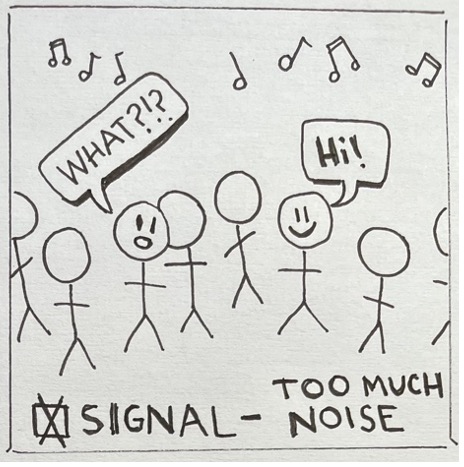
Signal not detected due to noise
Here we see someone not understanding the social bid by another person because there’s too much background noise. In the real world, this can be metaphorical noise, like if you have too much life stress, or your social limits are already maxed, then you might miss a bid for friendship.
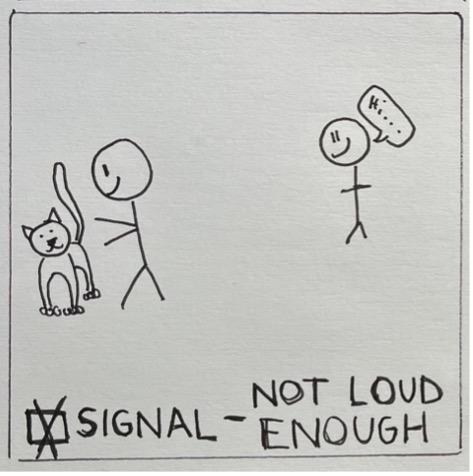
Signal not detected due to volume
Here we see someone missing a bid for socializing because the signal from the person isn’t loud enough to grab their attention. “Volume” of the signal is influenced by all sorts of things – attention, proximity, other distractions (like a cute cat).
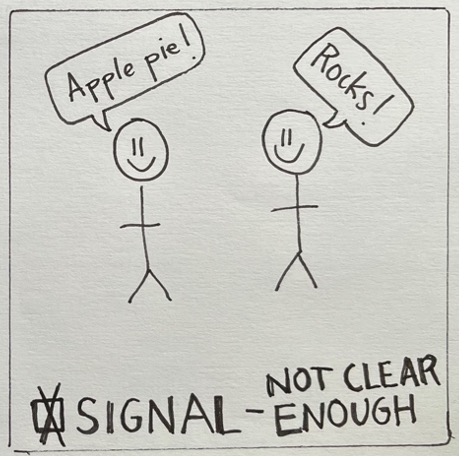
Signal not detected due to misinterpretation
Here we see both people missing a bid for socializing because the signals they are sending are not being accurately identified / interpreted by the other person (in the case of this image, one is interesting in connecting over baked goods and the other is interested in geology). Social signaling is different due to innumerable factors including cultural, generational, and subculture norms.
So, what’s the takeaway?
It’s easy to think that the signals you are sending are clear to the other person or that you’re properly understanding everyone else’s signals, but that’s not realistic. It’s worth taking time to think about what signals you believe indicate someone wants to be friends and the signals you rely on to find friends and to maintain friendships.
 The Friend Manual: How to make friends when you're bad at it