This is part of a series. Please check out this post for the beginning.
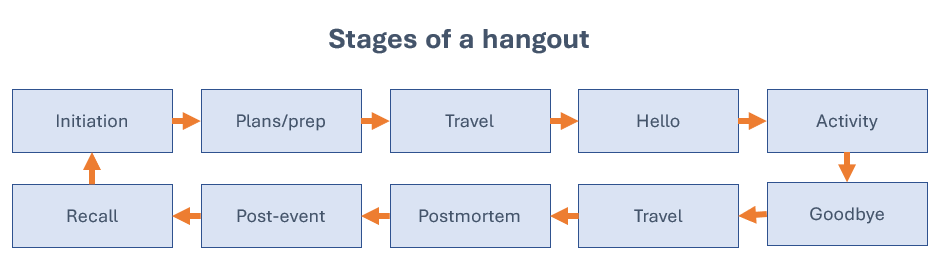
Here is the overall event/hangout diagram for reference. This post is going to talk about the breaks between stages (the arrows in the diagram).
What is a break?
Sure, this seems like a stupid question (many of the questions I ask seem this way). But, if you take a closer look, a break might be considered anything that interrupts the through line of how you carry stress.
The way you may likely carry stress is through the ways that you interact with the world that are weaker skills. E.g., if I struggle to pay attention for long periods of time, then giving myself an attention break like a nap or aimless walk, instead of redirecting my attention, like playing a game on my phone, might be more useful.
I think that breaks will mainly work when you take them intentionally. For example, you may inadvertently have a break when you show early to an event but spend the whole time stressing about the event or try to cram in three errands and stress yourself out before arriving if you’re not intentional.
An intentional break has three components: (1) state your intention to yourself “I’m taking a break” (2) do your chosen break (3) refocus on your intention for going to the event and what friendship goal you have in mind, e.g., “I’m here to interact with people and keep an open mind”.
This may seem goofy, but I think the bookends will help. I’m going to road test this in the wild for my next event.
What kind of breaks are there?
Here’s a couple I’ve thought of:
Redirect attention break
This is a break where you release tension by completely redirecting your attention to something else. One thing that helps redirecting attention is to set a timer so that you can full lose yourself without having to dedicate part of your attention to time passage. Ideally you will be so distracted that you forget where you are when the timer goes off.
Refocus intention break
In this type of break, you purposefully calm or redirect your energy while staying focused on the event. This is something you can do when your mind is in too much chaos or when stress events from the day/week/year are overwhelming you. Refocusing intention can give you license to put away all of those distractions for the timespan of the event.
Release energy break
Here, you move will your body in a way that releases tension for you. It could be a walk around the block or something more active. I used to have a gym available downstairs at my office, and when I was super stressed or angry, I’d sneak down in my office gear and lift a few heavy weights, walk back up the six flights of stairs and come back refreshed, if panting a little.
Sensory reduction break
Here, you remove yourself from loud noises, bright lights, eye contact, etc. Hopefully you will be alone, but anywhere quiet is good. This can be anything from just stepping outside for a fake phone call to hiding in the bathroom for a minute. Noise-canceling headphones also fall in this category.
Altered sensory break
Breaks like this exchange from one sensory experience to another. This helps if you have a preferred sensory experience, such as listening to preferred audio on headphones. You can also take a minute to seek new tactile sensations, like running your hand over a smooth wall, dipping fingers in a fountain, or running water over your hands or splash water on your face (which people seem to do a lot in movies and actually does work). Sitting on a different level, like sitting on the grass or reclining in a fancy chair/sofa can also do this.
Time break
Time breaks can be planned so that you have a decent amount of time between stages. E.g., spend the week before slowly cleaning up before an event at your house. Taking an earlier train into the city so that you can stop and have a cup of coffee and read a book before the event.
Call a friend break
Here, you can call a trusted friend and ask them to distract you. You don’t want to talk about the stress you’re feeling or the event itself. You can talk about anything else that will distract you and hopefully make you laugh. Same can be done for text. Imagine texting someone and asking to share 5 of the crazy gifs you can find back and forth and at the end see who “wins” the gif war. <– I’ve just made this up, and I think I am going to implement it ASAP.
Pre-planning break
Perform actions that make decision-making and leaving on time for your event easier. Lay out your clothes the night before if you find choosing clothes hard. Make a plate of food and put it in the fridge if eating is hard. Find out the train/bus schedule if you’re taking public transport and pack snacks. Choose a designated time to leave if you struggle with being at events too long. Removing common hurdles from your actual event day is helpful. (I always have trouble finding the right outfit if I am stressed and end up leaving late all the time because of it.)
Calorie bump break
Eat some food! This should occur if you’re someone who burns a lot of calories prior to and during social interaction and can get into the hangry zone pretty quickly. I also highly recommend this for events where you are meeting for dinner with a large group. I always make the mistake of not eating for a while beforehand because I want to focus on the food, and then it takes an hour for the food to come and I’m desperate by that point.
Conclusion – why do we need breaks?
Breaks are there to reduce stress so that it doesn’t carry over to the next stage of the event. The more stress I accumulate throughout the event, the less likely I am able to interact with people from a calm place where I can both enjoy other people and they can enjoy me (if we’re compatible). It also reduces the likelihood that you bring bad energy in from other sources, like the dreaded traffic stress.
 The Friend Manual: How to make friends when you're bad at it