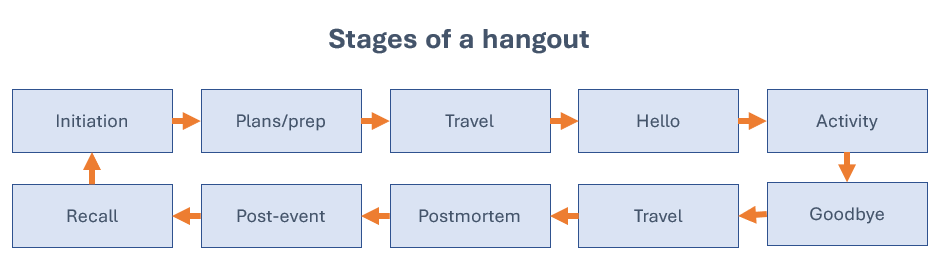
This is the first of a series of posts about memory. I’ve been having trouble sorting this all out and went down about 800 rabbit holes, so this is just a first stab at the memory recall step of the event stages, see the diagram of an event post for a recap.
A big ol’ disclaimer
These posts are a thought experiment based on personal experience, an armchair understanding of psychology and neuroscience-type stuff, and talking with other people about their experiences.
That said, it’s widely accepted that the following statements about memory are true:
- Memories are often inaccurate / incomplete
- Accessing memories later can allow you to change those memories
- You will remember things differently based on how you are feeling at the time you are creating the memory
Now that we got the disclaimer out of the way, let’s get on with talking about memory and memory recall.
What is “Recall”?
As you’ll remember, “recall” is the final stage in the stages of an event (hangout) graphic. And, while memories are created and accessed during this entire process, the most critical point for memories for friendship creation/maintenance is the point of recall because it induces us to hang out with people again and create more memories.
Memories are inaccurate / incomplete
I don’t know about you, but I used to have a really good memory. I could recall things with much more accuracy and prided myself on having a good memory with very little effort on my part. I used to think that because my memories had clarity to them that they were also “correct”.
It was something I took for granted and took comfort in.
But, in the last few years, I have come to question the accuracy of my memories. A couple of factors about me increase the likelihood that my memories can be a little suspect include:
- I have a tendency towards pessimism that can veer into extreme pessimism if unchecked
- I have social anxiety that gets worse depending on a variety of factors
- I have a tendency to ruminate on social interactions, especially when in a negative headspace
- My ADHD brain is getting more ADHD and the cracks are beginning to show
The first step to accepting that my memories are inaccurate and/or incomplete is to prove it. So, I will go through two separate scenarios to show both:
Scenario 1 – the Fireside Chat (proof of inaccuracy)
Here is a drawing I made after a group of us got together in someone’s backyard around a firepit. It was a great night and we all just hung around talking about a wide variety of subjects. I drew this that night after I got home to see if I could capture some of what made that night delightful and so that I could recall it with greater clarity later.
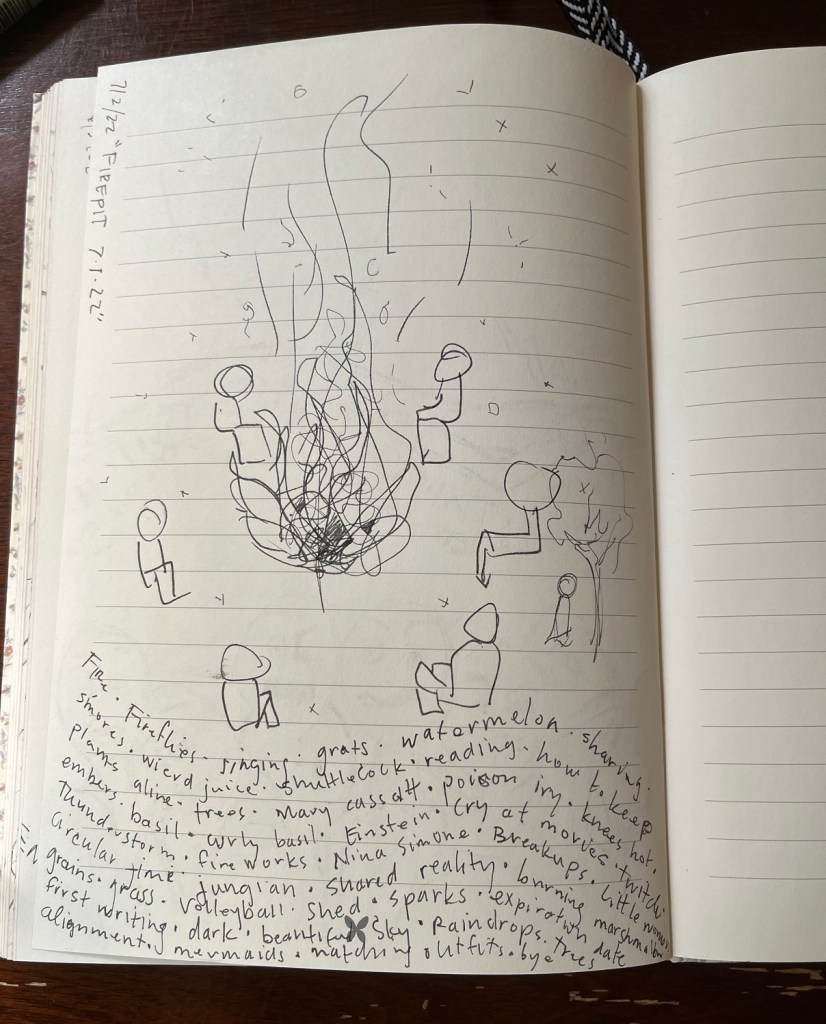
As an experiment, I wrote down words for subjects that were touched upon, things that happened, setting descriptors, etc. And I also did a little diagram of how we were seated.
I decided to limit myself to only what I saw, thought, and remembered about the meeting. And then I sent it to the people who attended the firepit. Immediately I got a message back saying “You forgot about the <insert his clear memory/interest>.” And I had forgotten about it because it wasn’t something my brain had held onto. However, once it was brought up, I did remember it.
This means that I could prove that the exchange was true, and that my memory was “false” because I didn’t remember the complete night even as I had experienced it.
Four months later, I only remember a few of the things on the drawing and I didn’t even remember the night until I was flipping through my journal and found the drawing.
Verdict: Memory fallibility +1
Scenario 2: A walk in the woods (proof of incomplete)
I took this picture on a recent walk with a friend and added some super realistic skeleton-y drawings to represent us.
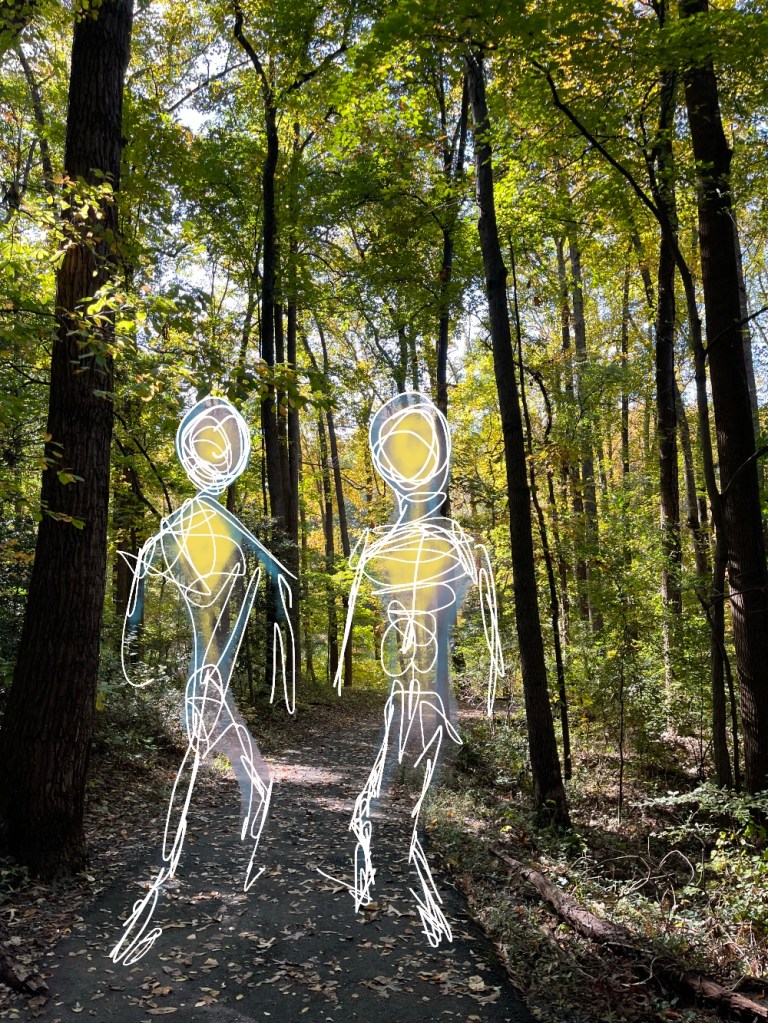
I have been thinking a lot about memory lately, so I decided to play with mine during this walk.
It was a beautiful day, so I would occasionally stop and really pay attention to the nature and leaves and light. When I would do this, I would spend 100% of my focus on the setting, so I have some very clear memories of different vistas during the walk. These memories look like the image above.
However, I was walking and talking and it was quite a long walk. I can’t maintain 100% of my attention on anything very long, because that’s just exhausting and would use too much brain power.
One thing I’ve learned in a bunch of different places is that memories are often “saved” as simplified version of events (here is where a dedicate person would add a link to primary sources material).
For the portion of the walk that was in the forest, my memory may function more like this image below. I have a general impression of trees and foliage, a path we are walking on, and two people existing on the path. Working memory creates a shorthand in the brain so that we can concentrate on other things when setting/walking is on autopilot.
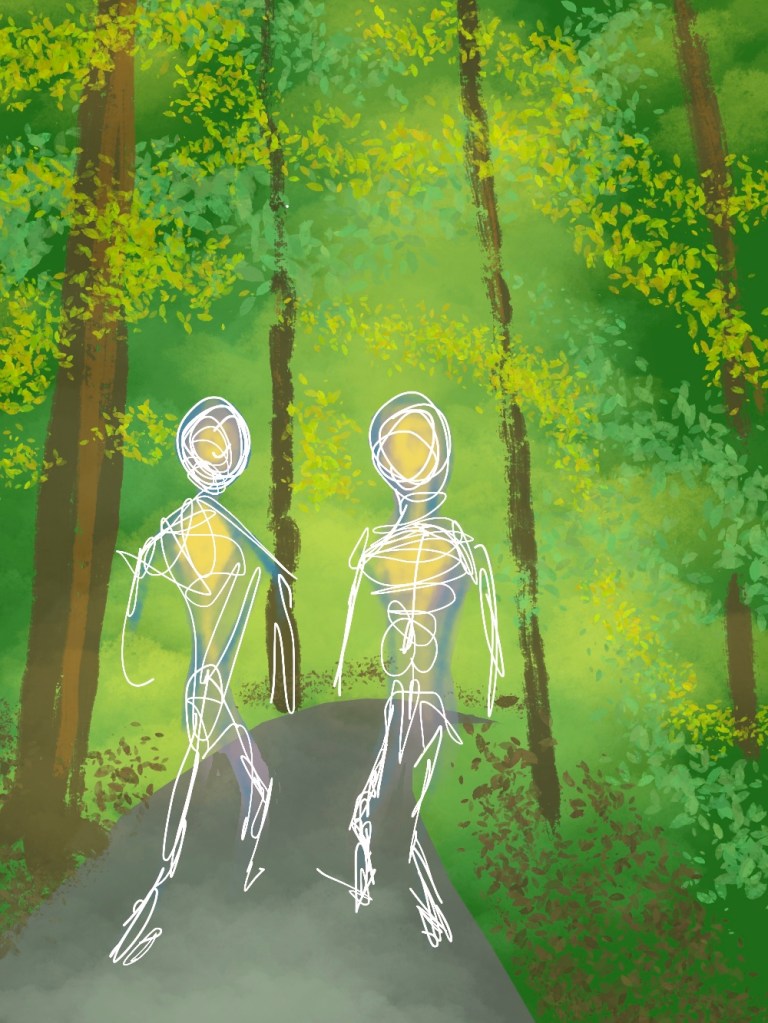
Because I was able to be on autopilot, my memory of the walk is a series of different inputs and processing that I toggled between while walking and being social. Like the image below, I experienced my internal monologue, and then experienced motion through the forest, and then focused on the conversation between me and my friend.
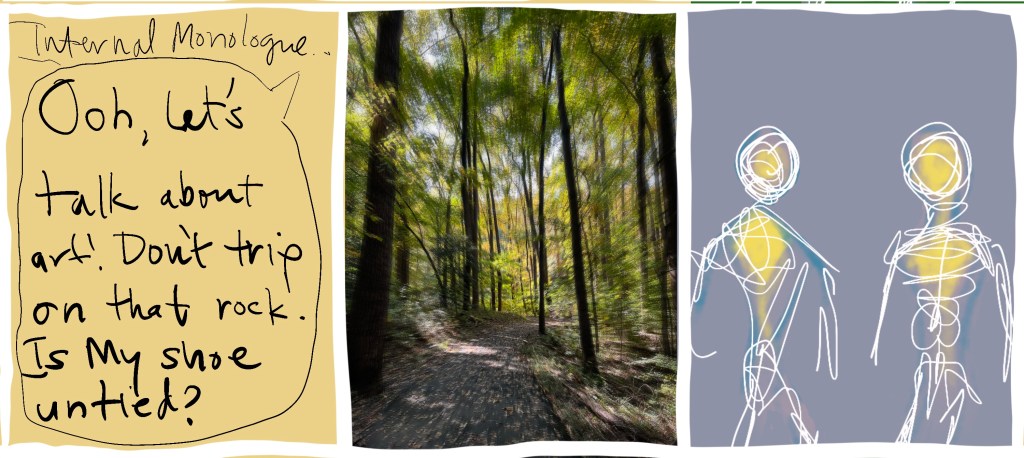
So, when I think back on the walk, I initially assumed I experience the entire walk seamlessly. My memory recall was actually a bunch of random information stitched together based on where my attention was located at the moment, and how much was focused on something at the time. And now, a few weeks out from the walk, my memory is even more fragmented because my short term memory has deleted a lot of the unimportant info and rewritten it with more recent experiences.
Verdict: Memory fallibility +2
Huh what? What does this even mean? (conclusion)
If I can prove that my memories are both fallible and malleable, then they are also something that I can manipulate for good.
For years, my memories may haven’t served me well. They have kept me from trying things again that I may have enjoyed at the time or that would have sufficed as “within acceptable parameters“. They have suggested I hold grudges when perhaps I shouldn’t have and on the flip side, told me to forgive when I shouldn’t have.
With all this info, I am trying to figure out what strategies give me the best relationship between me, my memory, and the present to make my best future possible. I’ll be doing some road test with written and drawing journaling and event post-mortems and see which works best for me.
 The Friend Manual: How to make friends when you're bad at it